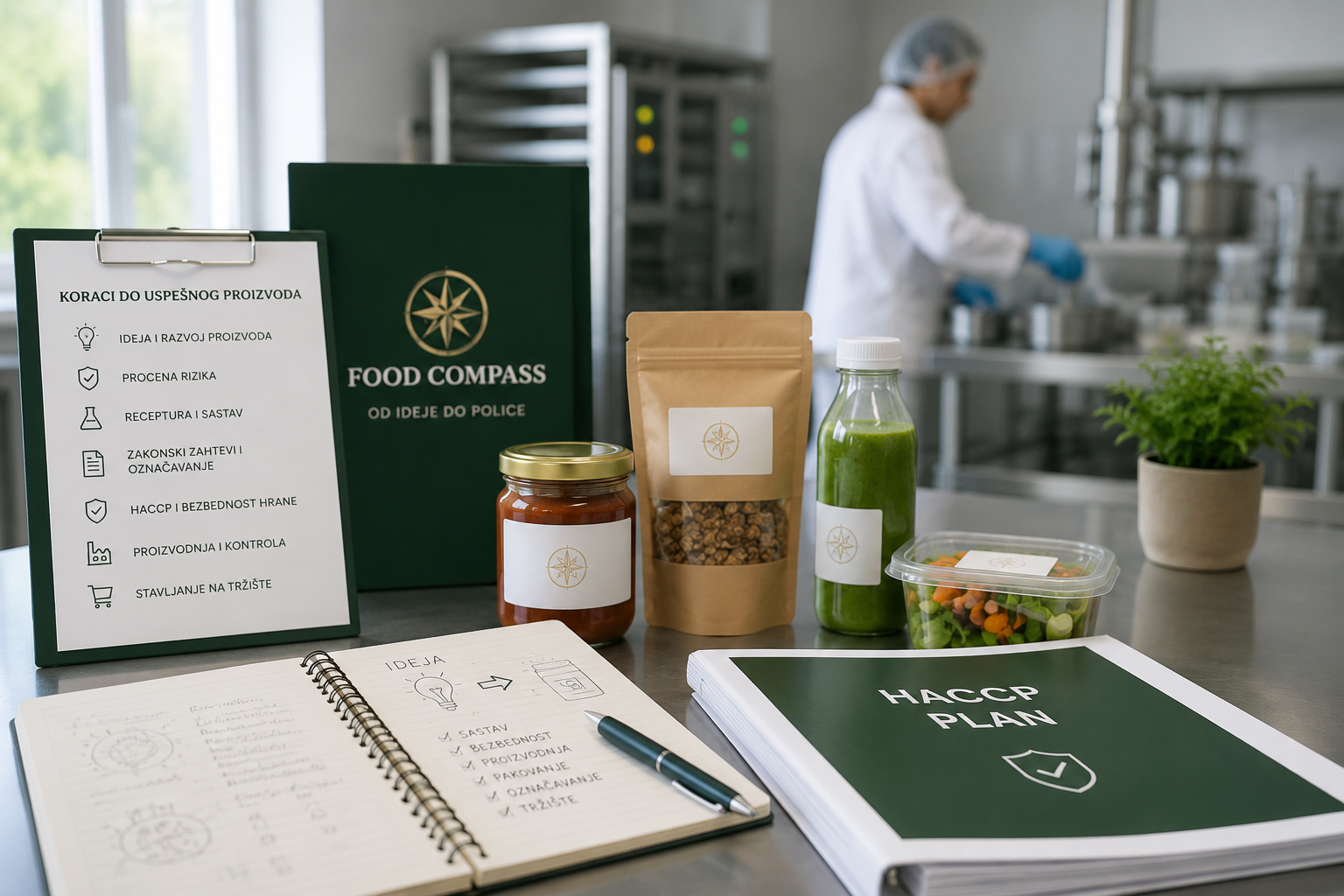
From the idea to the product on the market - what all needs to be done before the food product reaches the consumer?
You have an idea for a food product. Maybe you've come up with the recipe, found the packaging and are already thinking about selling it.
But between a good idea and a product that can be put on the market there are a number of steps that should not be skipped.
Food production involves much more than the production process itself. It is necessary to provide appropriate conditions for the operation of the facility, fulfill requirements regarding hygiene and food safety, establish appropriate procedures and records, define the product and its specification, ensure the necessary checks and analyses, properly declare the product and ensure the conditions for its storage and transport.
In other words – the path from idea to shelf has several important stops.
1. The first step - the corresponding object
Before starting production, it is necessary to determine what conditions the facility must meet for a specific type of activity.
Requirements depend on what is produced, processed or marketed, as well as on the way the process is organized.
The facility must be properly designed and organized to ensure hygienic conditions and prevent food contamination. This includes, among other things, the appropriate arrangement of rooms and equipment, flows of people and materials, conditions for cleaning and maintenance, waste management and other hygienic prerequisites.
Before investing significant money in furnishing the space, it is therefore useful to make an expert assessment of the planned object and process.
A good estimate at the beginning can prevent costly changes later.
2. Registration and conditions for performing activities
In addition to the facility itself, it is necessary to fulfill administrative and regulatory requirements related to the specific activity.
Special requirements apply to subjects in the food business, depending on the type of food and the activity they are engaged in. One of the important elements of the system is the registration of the object in the appropriate register, i.e. the Central Register of objects when it is prescribed for a specific activity.
That is why the first step is not to "create HACCP documentation", but to determine what is specifically needed for the facility and activity that you want to register.
3. Food hygiene - a prerequisite for a safe product
A safe product cannot be created in an inappropriate environment.
Before establishing the HACCP system, it is necessary to ensure appropriate hygienic prerequisites. They include everything that allows the production process to take place under controlled conditions.
This includes, depending on the type of activity:
- hygiene of space and equipment;
- cleaning and disinfection;
- pest control;
- equipment maintenance;
- water quality and safety;
- waste management;
- personal hygiene of employees;
- control of raw materials and suppliers;
- proper storage and transport conditions.
These elements are not just formal documentation. They must be established and applied in daily work.
4. HACCP - how to control hazards in the process?
The HACCP system is one of the key elements of food safety management.
Its essence is not that there is a folder with HACCP documentation, but that in the actual process hazards that can threaten food safety are recognized and controlled.
This implies:
- description of the product and its purpose;
- description of the production process;
- identification of possible dangers;
- risk assessment;
- defining control measures;
- determining appropriate control points, when applicable;
- defining the tracking method;
- procedure in case of deviation;
- system verification;
- relevant records.
HACCP should be adapted to a specific product and process, not a generic document taken from another business.
5. Manufacturer specification - what exactly is the product?
Each product should be clearly defined.
The manufacturer's specification is an important document that consolidates data about the product and its characteristics, in accordance with the requirements that apply to a specific product category.
Depending on the product, the specification may include data on composition, product characteristics, requirements for raw materials, production method, storage conditions, shelf life and other relevant data.
It is not just a document "for the drawer". A well-crafted specification is the basis for linking the recipe, production process, safety, quality and declaration.
6. Analyzes and proof of product conformity
Depending on the type of product and relevant requirements, it is necessary to define appropriate laboratory analyzes and other ways of checking product safety and quality.
The analysis plan should not be made randomly. It is necessary to take into account the type of product, raw materials, production process, potential hazards, product characteristics, shelf life, storage conditions, relevant regulations and customer requirements.
In other words, the analyzes should be linked to the risk assessment and the characteristics of the specific product.
7. Declaration - what the consumer must know?
Before the product reaches the consumer, proper labeling should be provided.
The declaration must contain information that is prescribed for a specific type of food, and the data must be accurate, clear and compliant with the applicable requirements.
Depending on the product and the method of sale, there may be relevant data such as the name of the food, list of ingredients, allergens, net quantity, shelf life, storage conditions, data on the entity in the food business, nutritional declaration and other mandatory information.
Special attention should be paid to allergens, nutritional and health claims, as well as information on origin, when applicable.
Declaration regulations change, so before printing the packaging it is important to check the requirements that are valid at the time the product is placed on the market. Changes to the rules in the field of food labeling were also introduced in Serbia during 2026, including new rules that apply from July 1, 2026 for certain categories of products.
8. Packaging is not only design
Packaging plays an important role in preserving the safety and quality of the product during its shelf life.
That is why the choice of packaging should be considered together with the characteristics of the product, the method of packaging, storage and transport conditions.
Beautiful packaging attracts the customer. Appropriate packaging protects the product.
9. Transport and storage - the chain does not end with production
A product may be properly manufactured, but its safety and quality may be compromised if it is not stored or transported under appropriate conditions.
It is necessary to define appropriate storage and transport conditions depending on the characteristics of the product.
Temperature, hygiene of the means of transport, protection of the product from contamination, method of stacking and other conditions can be of crucial importance.
That is why transport should be seen as an integral part of the food safety chain, and not as the last step that is solved only when the product leaves the facility.
10. And what about when the product finally hits the shelves?
Then the work is not necessarily finished.
The product should be monitored throughout its life cycle – from production and distribution to the market.
This includes maintaining the food safety system, monitoring changes in regulations, updating documentation and declarations, checking traceability, dealing with deviations and preparing for controls and audits, when applicable.
For companies wishing to operate according to international standards, additional requirements may arise from standards such as IFS, FSSC 22000, BRCGS or ISO 22000.
From idea to shelf
Starting food production is therefore not a single task. It is a series of interconnected steps:
IDEA → PRODUCT → FACILITY → HYGIENE PREREQUISITES → HACCP → SPECIFICATION → ANALYSIS → DECLARATION → PACKAGING → STORAGE AND TRANSPORT → MARKET
When these elements are properly connected, it is much easier to manage the product, prove its compliance and respond to market demands.
Food Compass – your guide from idea to shelf
Development of a food product does not have to be a journey through unrelated requirements, documents and regulations.
Food Compass provides professional support in product definition, regulatory compliance, HACCP systems, manufacturer specifications, declaration and preparation of products for the market.
You have an idea. We help you find the right path.